Axari gives Chief Information Security Officers something they'd never had: a dependable AI team that organises the work, prepares the decisions, and cuts the noise — without taking away their accountability.
I joined in June 2025 as Product Design Engineer and spent a year designing and building the agentic experience end to end — from the first research artifact to a production rebuild I designed and coded.
Every company has one person accountable for keeping it secure: the CISO — the Chief Information Security Officer. If anything goes wrong — a breach, a leak, a failed audit — it lands on their desk. Yet their day works against them: dozens of security tools, filtered reporting, endless busywork, and no single honest view of the work.
Axari is an AI operating system built for that person. Instead of another dashboard, it gives the CISO a team of AI employees — coordinated by an orchestrator called Chief — that quietly prepares the work and surfaces only what needs a human.
The heart of the design problem was autonomy — how much an AI may do in the name of someone who carries legal accountability. The whole product rests on three operating modes we designed around:
Human in the Loop
The AI prepares; the person decides. Every consequential action needs explicit approval.
Human on the Loop
The AI acts with oversight. The person watches the trail and can intervene or reverse.
Human out of the Loop
Lower-risk, repeatable work the AI completes on its own — logged and auditable.
I joined Axari in June 2025, as the product designer on a team of ten. The founding team had already spoken with dozens of CISOs and the pain was proven. But what the product would actually feel like — the UX of an AI workforce — was still wide open. I worked alongside the CEO, PM, and AI researchers in every sprint.
The problem we were chasing was specific:
Teams report upward only the good news, so the CISO gets a filtered, rosy picture of the company's security.
Chasing updates, collecting reports, preparing audits — hours of manual work before any real security thinking begins.
Firefighting today's noise leaves no time to fix what's actually weak.
When the board asks "is our security investment working?", there's no clear answer.
The problem was never a shortage of tools. What CISOs lacked was a single, reliable view of the work — and the job of interpreting it all was left to them.
Cybersecurity was new to me — dense with vocabulary, workflows, and acronyms. So I spent my first weeks not sketching, but asking. Sitting in CISO interviews. Reading incident reports. Learning why compliance frameworks like SOC 2 and ISO 27001 consume entire quarters of a security team's time.
Then I went deeper into the role itself: I helped run structured interviews with practicing CISOs and Heads of Security, built a persona I could rehearse against, and mapped a "day in the life" — including how a high-alert day differs from a normal one. The questions were open-ended on purpose: walk me through yesterday; if you could hire three people tomorrow, what roles would they be; which decisions can only you make?
What the interviews taught us:
They knew who they'd hire
The "who would you hire" answers repeated: an assistant for inbox and calendar, a coordinator to chase status, a compliance handler, an analyst. They just couldn't get the headcount.
The work was predictable
The same six-to-eight workflows recurred in every org — questionnaires, evidence collection, report prep — and most of each was chasing and formatting, not judgment.
Trust is earned in steps
No CISO would accept blanket automation — but every one was willing to expand an AI's autonomy per task, the way a new hire earns it.
The research also exposed a trap. When a system can fetch, compute, and summarise almost anything, the temptation is to show everything — every feed, every signal, every number, now correct and real-time. But volume was never the CISO's problem. Interpretation was. That split became the clearest division of labour on the team:
The feeds, signals, and numbers have to be right. A hard, essential data and security problem — but not where design earns its keep.
Deciding which data actually helps a CISO make the decision in front of them — answerable only by understanding their day, their priorities, and what each decision needs.
Making the data accurate is an engineering problem. Making it relevant — deciding what actually helps a CISO act — is a design one.

When we asked security leaders which roles they would staff first if given the headcount, the answers converged: administrative support, program coordination, compliance ownership, analysis. That pattern shaped Axari's core decision — not a single generic AI assistant, but a team of specialised AI employees, each with a name, a role, and a defined scope of responsibility.
Giving the agents names and personalities was a deliberate design choice: it let the CISO mentally model who does what. Never "the AI" — always "ask Janice" or "Eve flagged this". Identity creates accountability, even for software.
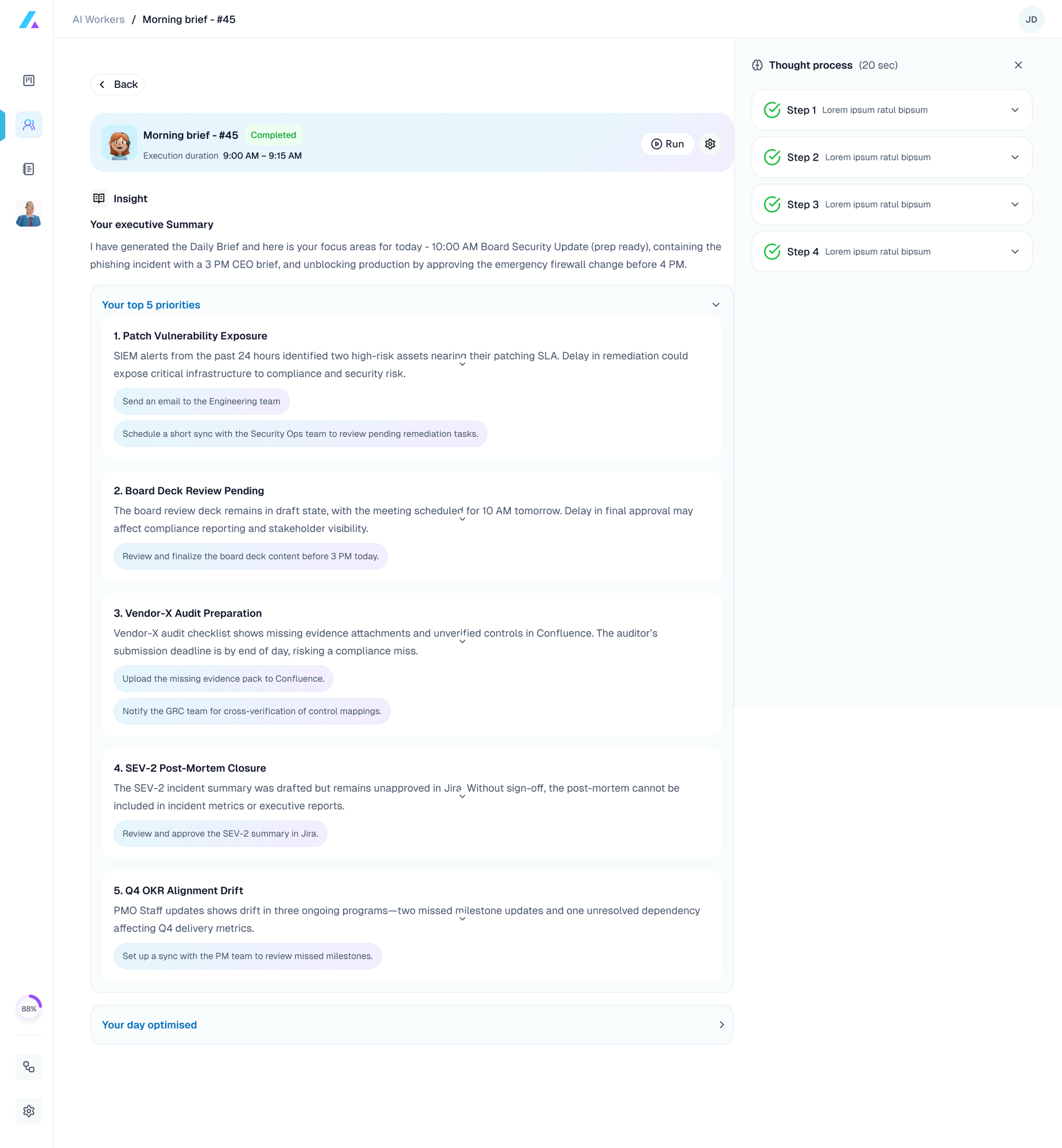
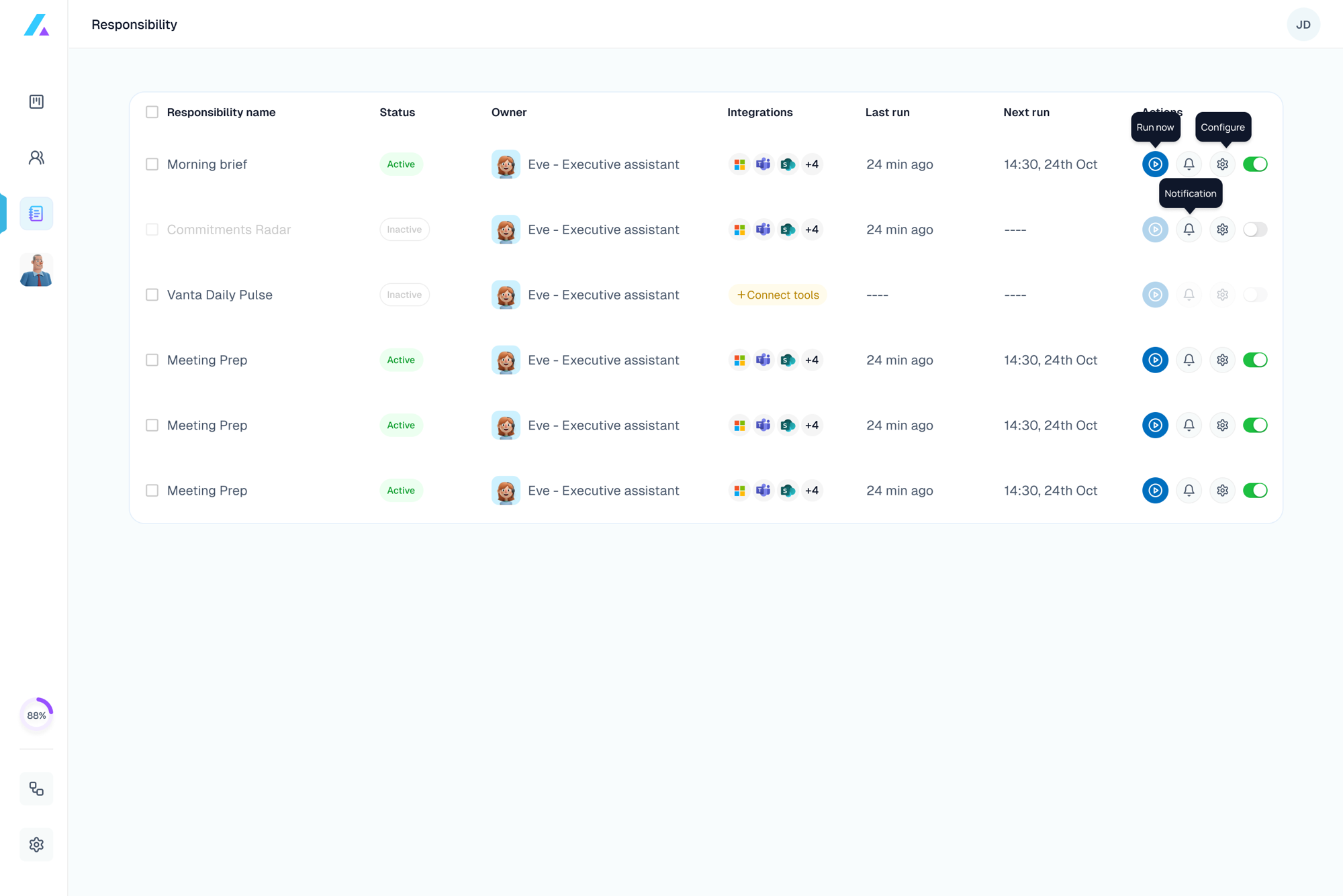
Each agent's work was packaged as a Responsibility — a playbook that runs on a schedule or trigger, with steps mirroring exactly what CISOs described in the interviews. Responsibilities made the system predictable: the CISO could see what each agent would do, when, and why. That predictability was the foundation of trust — and in the first version, every consequential action still required explicit human approval. Human in the loop, by design.
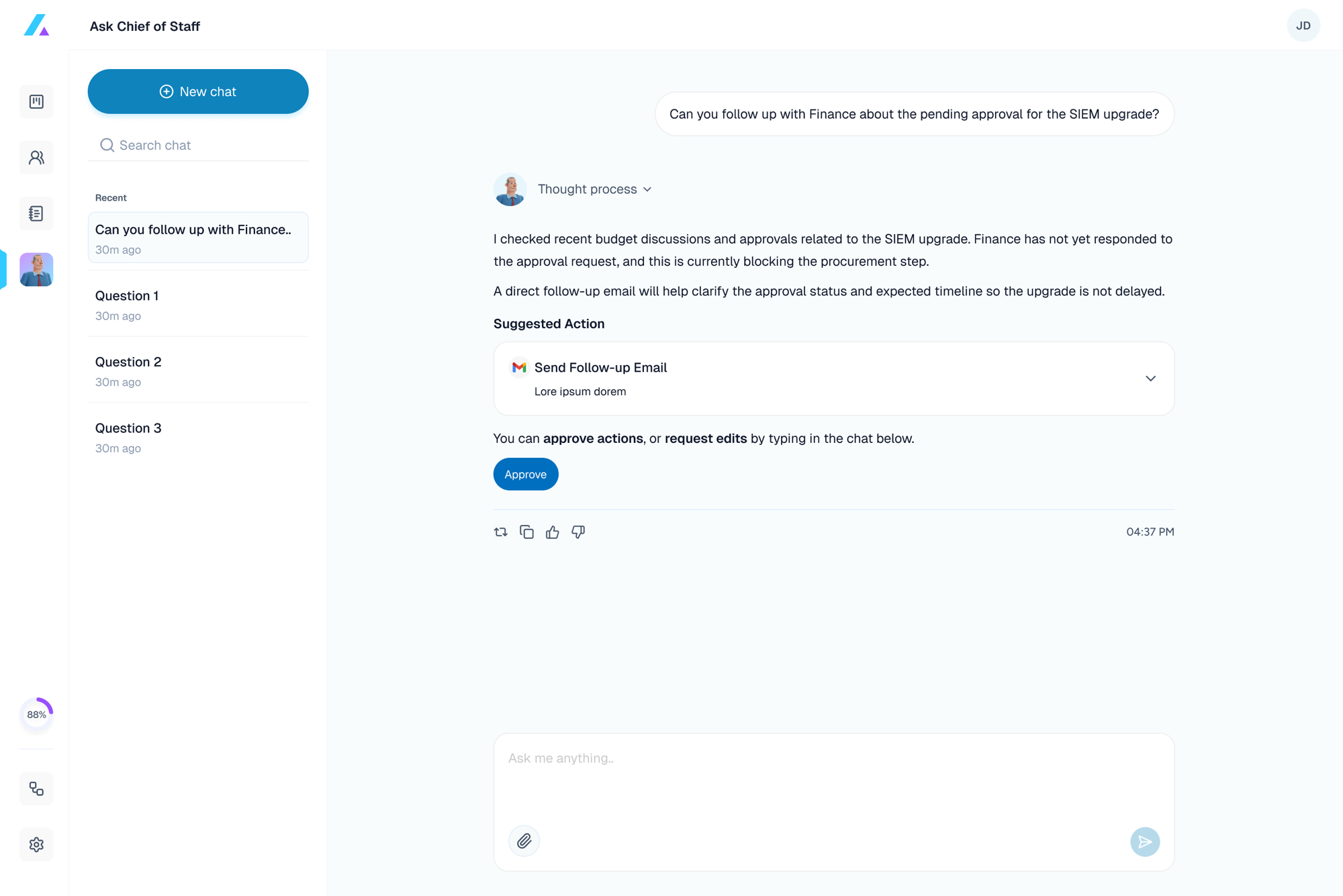
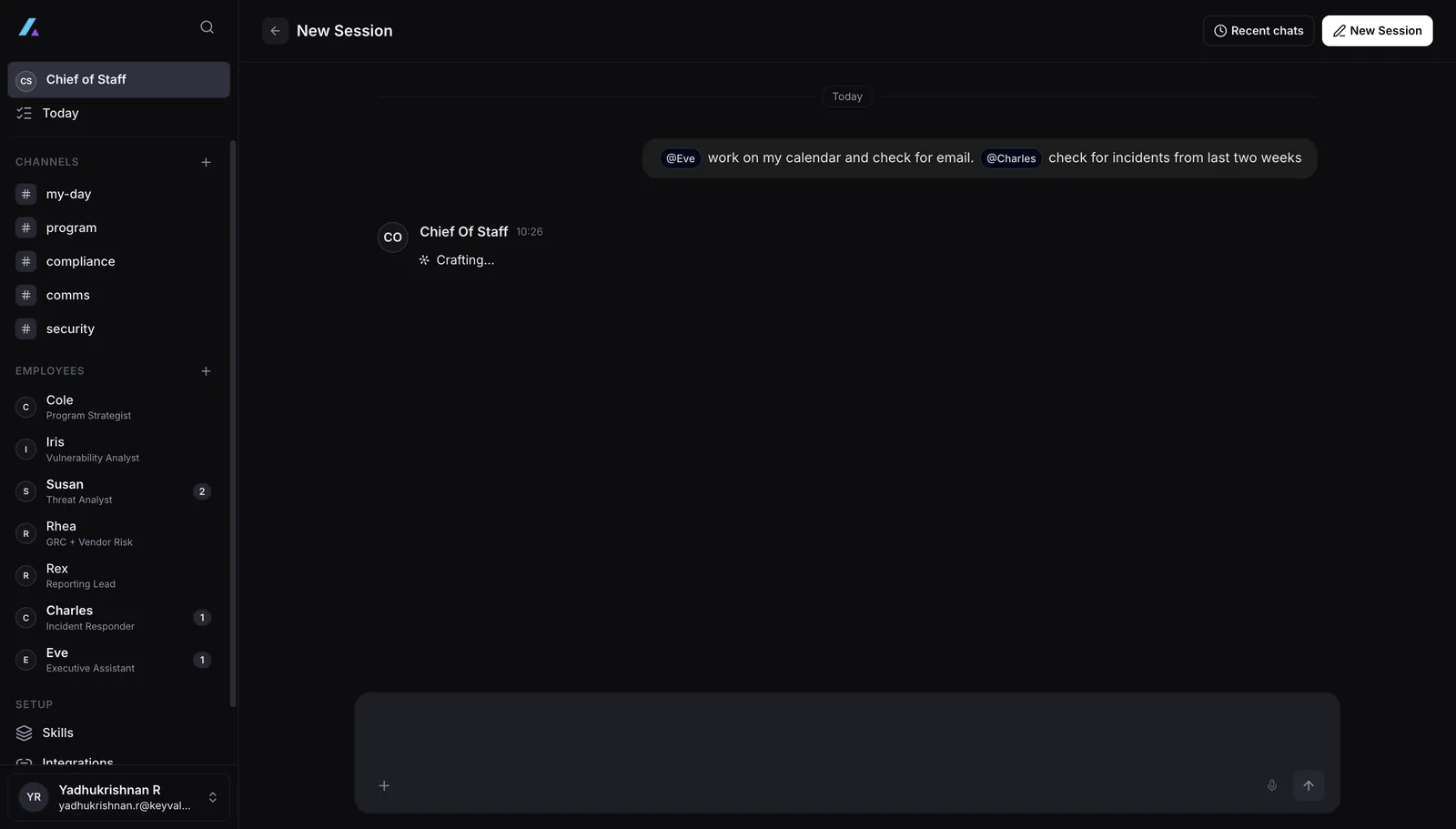
Chief is the CISO's one point of contact. It understands the wider context, routes work to the right specialist in the background, and surfaces the result wherever the CISO already works.
ChiefOrchestrator
EveExecutive Assistant
JaniceProgram Manager
SageStrategy Analyst
RheaIntel & GRC Manager
Triages email, manages the calendar, prepares meeting briefs, filters noise. Runs the 07:30 Morning Brief — an overnight sweep of email, Teams, Defender, Jira, and calendar, delivered as one prioritised read.
Why she existsThe most-requested hire in every interview: someone to own the inbox so the day starts with decisions, not triage.

Tracks OKRs, milestones, and owners. Every Monday she checks open milestones, spots owners gone quiet for a week, drafts the nudges, and summarises what's on track vs at risk.
Why she existsProgram drift was invisible until too late. CISOs wanted a coordinator who closes loops without being chased.

Measures security maturity across five dimensions, tracks it sprint over sprint, and points to where the next dollar buys the most risk reduction. Also watches vendor risk across the ecosystem.
Why he exists"Is our security investment working?" had no answer. Sage exists so the CISO can walk into the board room with one.

Owns compliance and threat intelligence — SOC 2, ISO 27001, NIST. Monitors control gaps and audit deadlines continuously, and filters daily threat intel for what actually touches this company's stack.
Why she existsAudits ate entire quarters, and by the CISOs' own account most of it was coordination, not judgment — big enough to deserve its own hire.
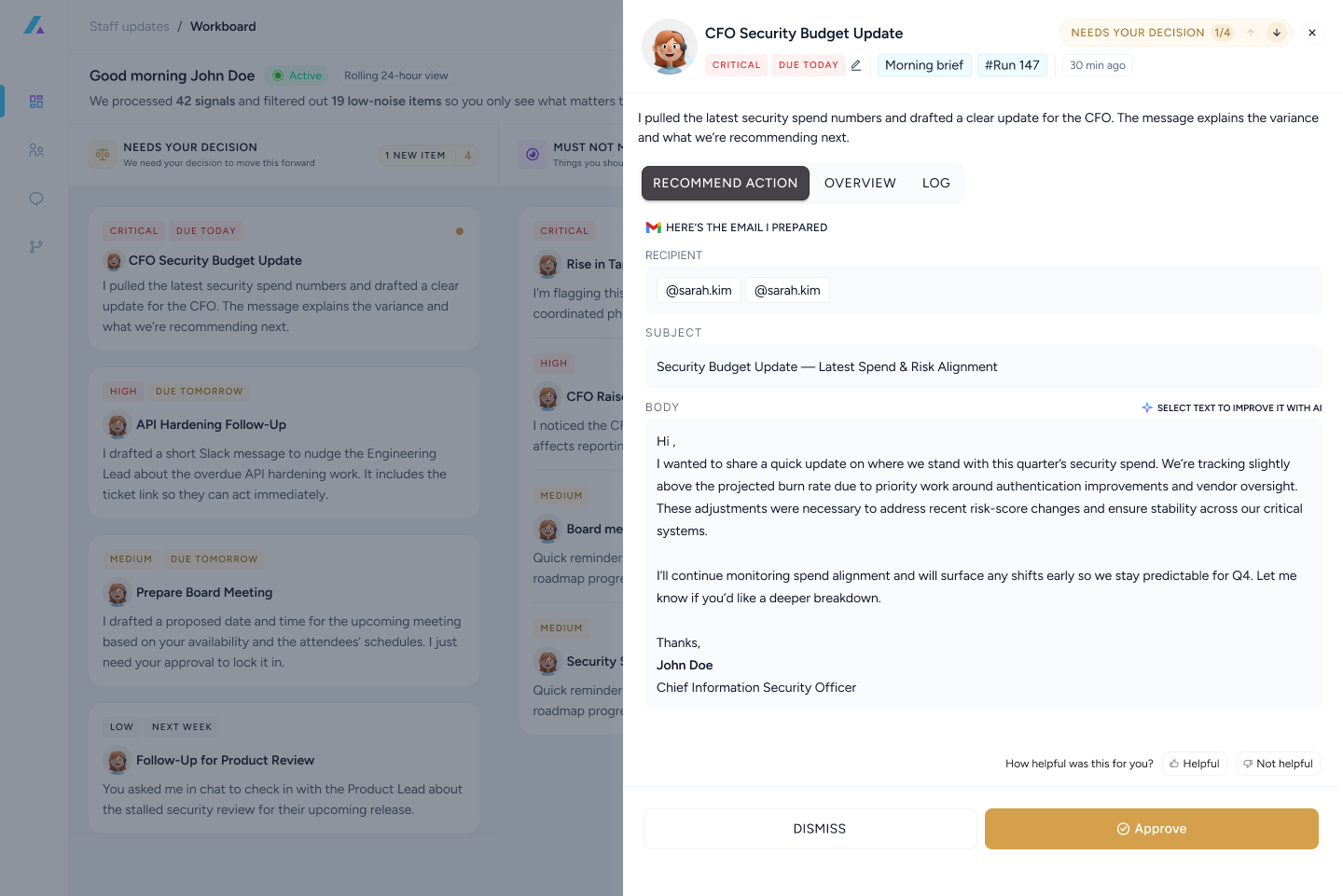
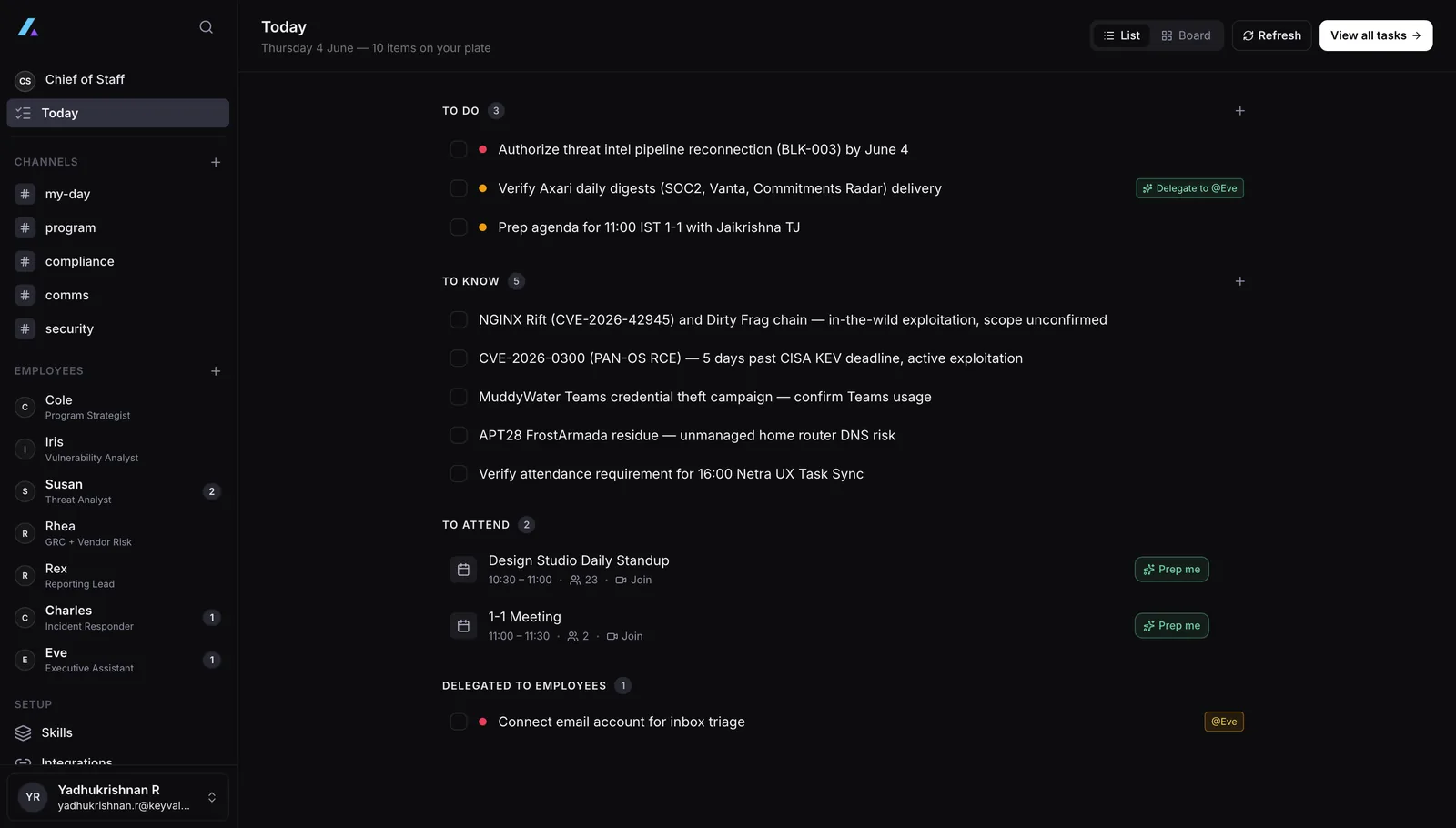
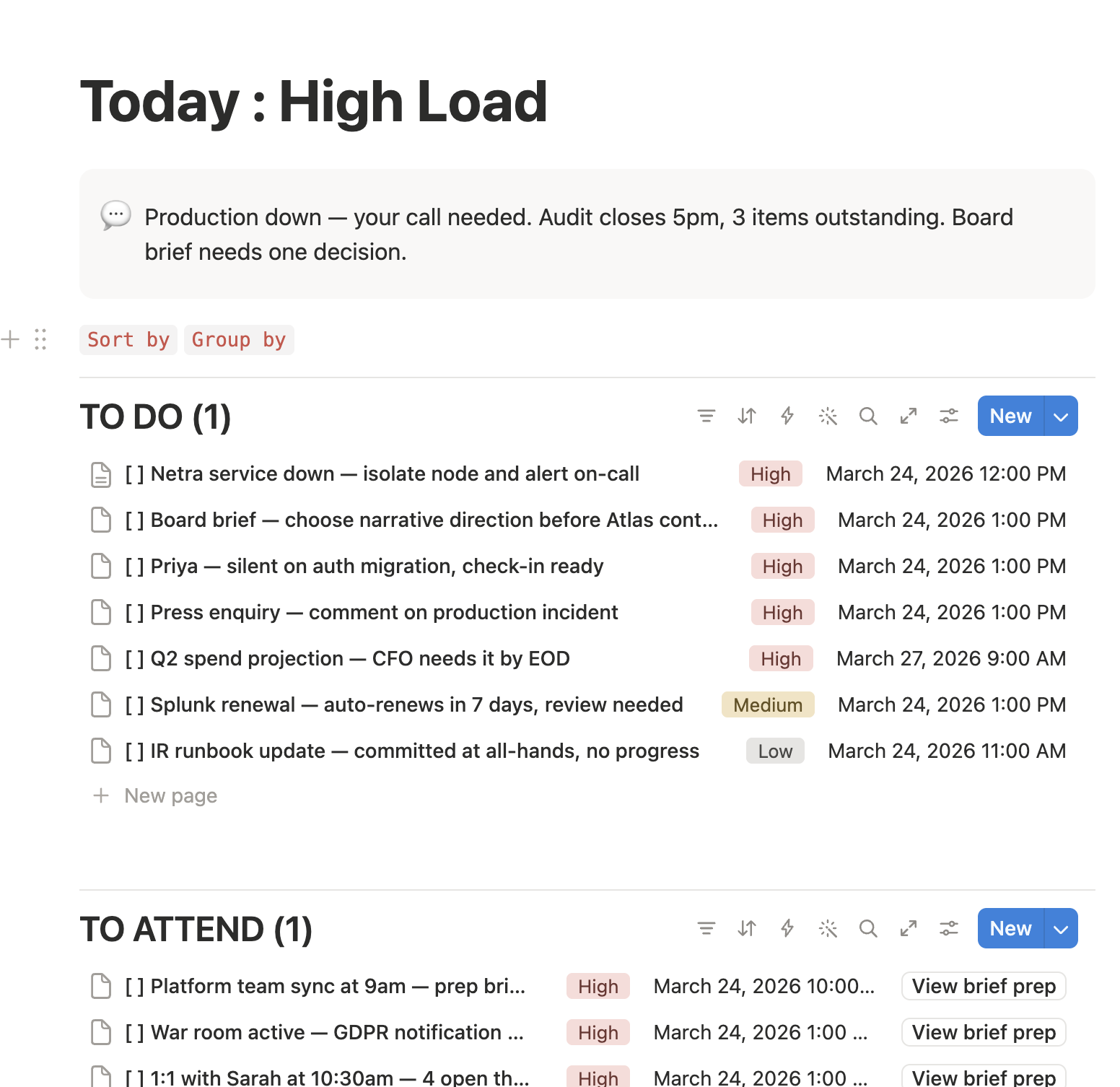
The daily home for all of this was the workboard — the day sorted into plain buckets, so a CISO could see what mattered without inspecting every system. Opening any item showed full context, the agent's reasoning, and a prepared draft: approve, edit, or dismiss.
We put the MVP in front of the CISOs who had shaped the discovery. The response validated the core idea — an AI operating team that prepares the work while the human keeps the judgement — and the work contributed directly to the company's next chapter.
The MVP and its validation contributed to Axari raising a $13 million seed round.
What security leaders said, in their own words:
We then tested the experience properly: structured sessions with 45 CISOs and Heads of Security from mid-market and enterprise companies — each one walked through the core workflows, followed by a debrief. The CEO ran the sessions; I worked through the recordings and transcripts, synthesised the findings, and turned them into the design brief for what came next.
What the feedback confirmed:
The concept was right. Participants understood and valued AI employees with a defined scope. Chief's plain-English interface and the proactive surfacing of items rated strongest — and human-in-the-loop gave users genuine confidence, because they could always see what the system was about to do before it acted.
What the feedback rejected:
"I do not want to learn another platform. I want to show up and be taken care of."
CISO · from a validation session transcriptOne more tool to manage
These leaders already ran twenty-plus security tools. Axari asked them to learn its structure — Responsibilities, Workboard, configuration — before it delivered value.
Read as a SaaS dashboard
Visually and structurally it felt like another SaaS product with AI underneath — undermining the promise of "a team that works for you".
Managing, not supported
In their words: they felt like they were managing the tool rather than being taken care of by it.
The conclusion was clear: keep the agents, the Responsibility model, and the trust framework — rebuild everything the user sees and touches.
The rebuild reorganised the product around what the CISO needs to accomplish — not what Axari can do. Every screen was re-asked from scratch: what is the CISO trying to do right now, and what's the minimum surface they need to do it? I designed the system — and this time also built the production front end with Cursor and Claude Code, working in the same repository as the engineers.
What changed, and why:
One curated briefing instead of a dashboard: To Do (needs a decision), To Know (intel that matters), To Attend (meetings, pre-briefed), Delegated (handed to agents). Ten items, no noise.
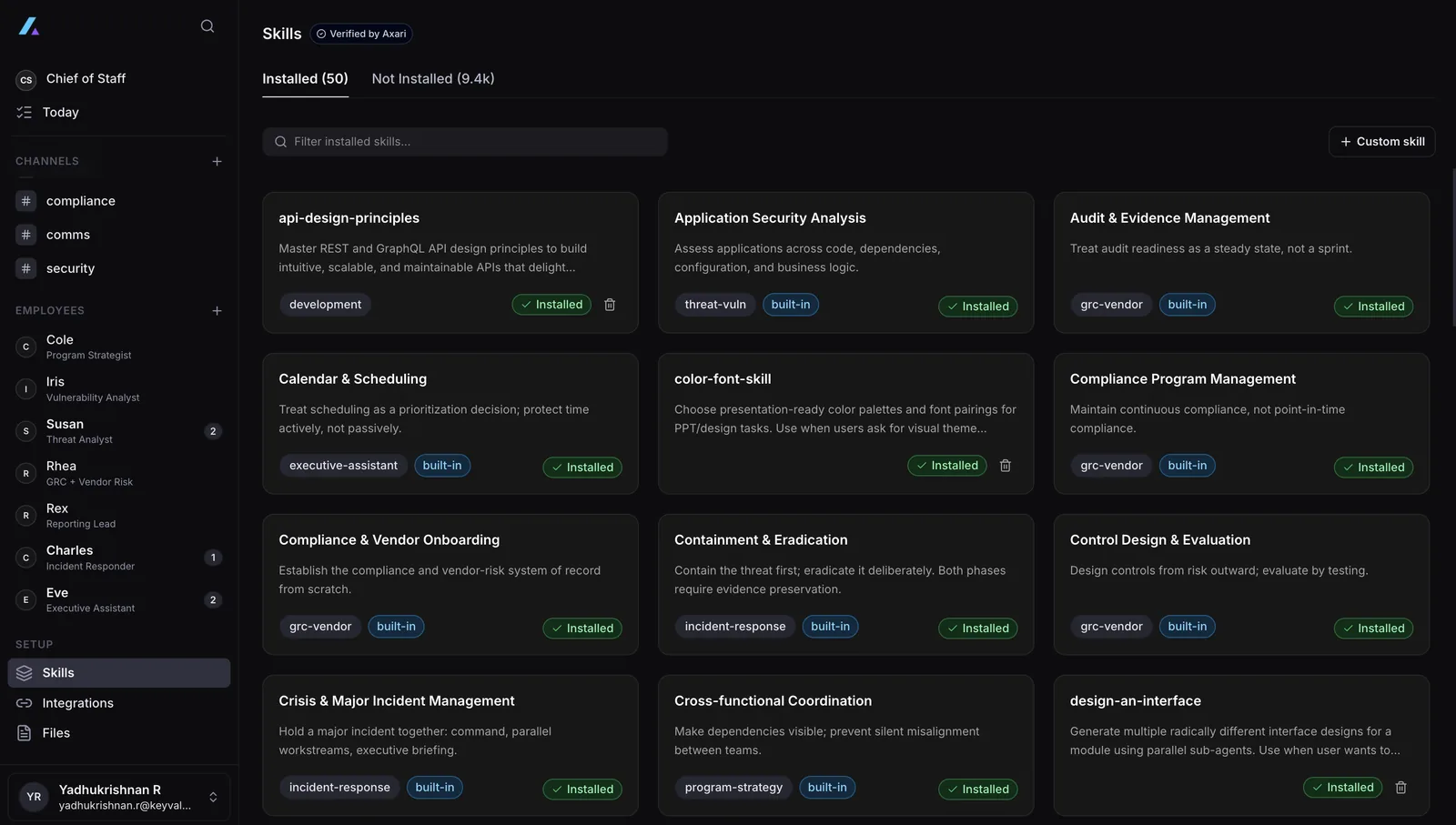
The fixed roster became composable: create any agent, assign skills and integrations, and point a team at a goal — "SOC 2 Renewal", "Vendor Risk Q3". No ceiling on the team.
In V1 every request went through Chief. The rebuild opened DMs with every employee — message Eve or Rhea like a colleague on Slack. Chat stayed a power tool, deliberately not the primary UI.
Approval-for-everything became a dial. Each Responsibility sits at the level of trust it has earned — and the CISO can move it.
External comms, vendor approvals, board reports. The AI prepares a complete draft with visible reasoning; the person approves in thirty seconds.
Status nudges, scheduling, evidence collection. The AI acts on schedule; every action lands in the audit trail with full provenance, one click to reverse.
Monitoring, background research, brief prep. The system runs the routine program quietly — logged, auditable, never demanding attention.
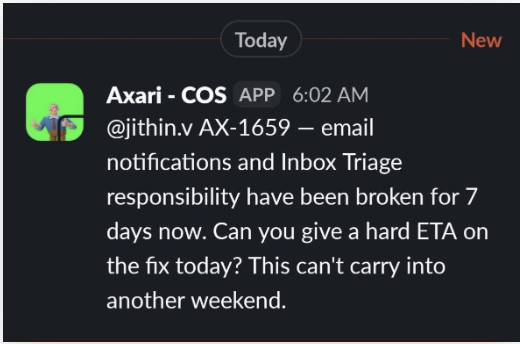
The impact: the product stopped presenting itself as a platform to operate and started behaving like a staff that reports to you. The working relationship moved to where CISOs already live — Slack, Teams, email — and the direction was strong enough that after my time there, Anthropic's CISO joined Axari as an advisor.
Axari was my entry into designing agentic experiences — and it taught me that they're shaped by two forces at once: a deep understanding of the user, and an honest grasp of what's feasible for engineering. Designing between those two is the real skill.
I worked with a team that collaborated closely with leading AI companies like OpenAI and Anthropic. As a product designer, that proximity sharpened my thought process — how to reason about AI products, and what quality looks like at that level.
I learned by doing the hardest version of the thing: helping build the first security-centric operating system with AI agents, from zero — research to shipped product, twice over.
AI should not only automate tasks. It should make priorities, ownership, progress, and decisions easier for people to understand.
On my last day, notes from the people I built it with — the part I'm quietest and proudest about.
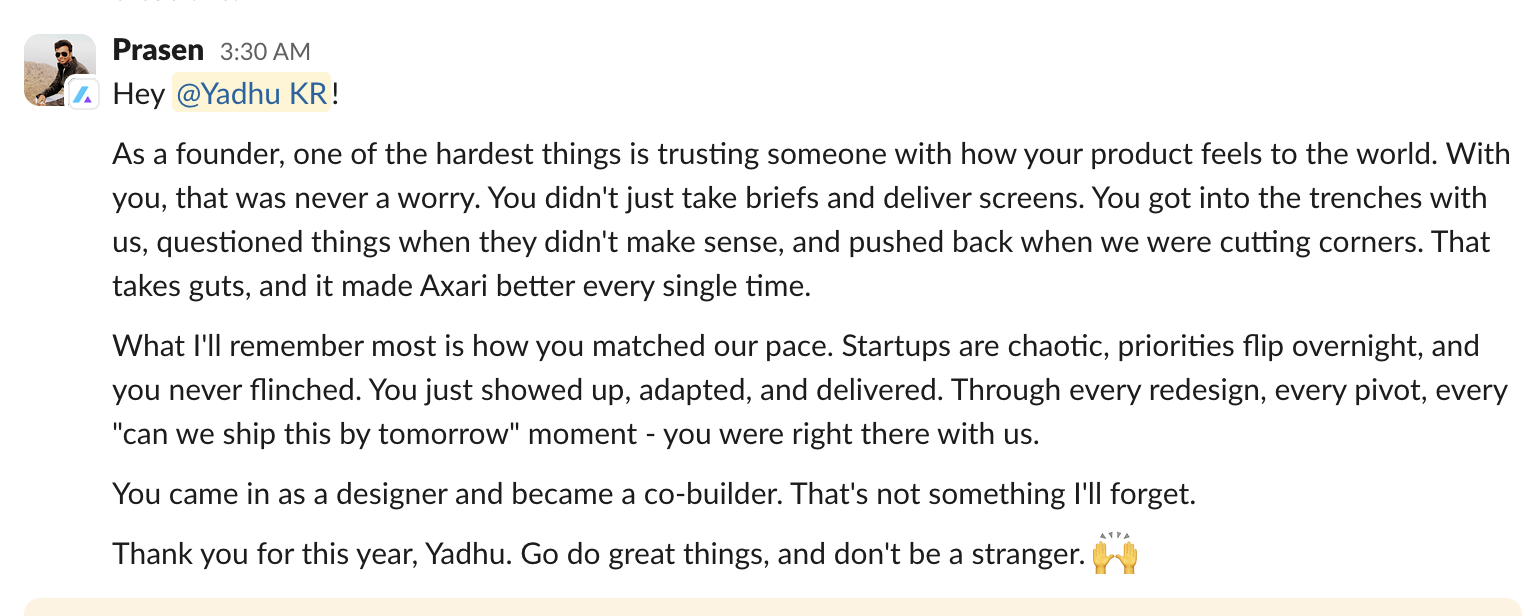
Prasen Shelar · Co-founder & CEO
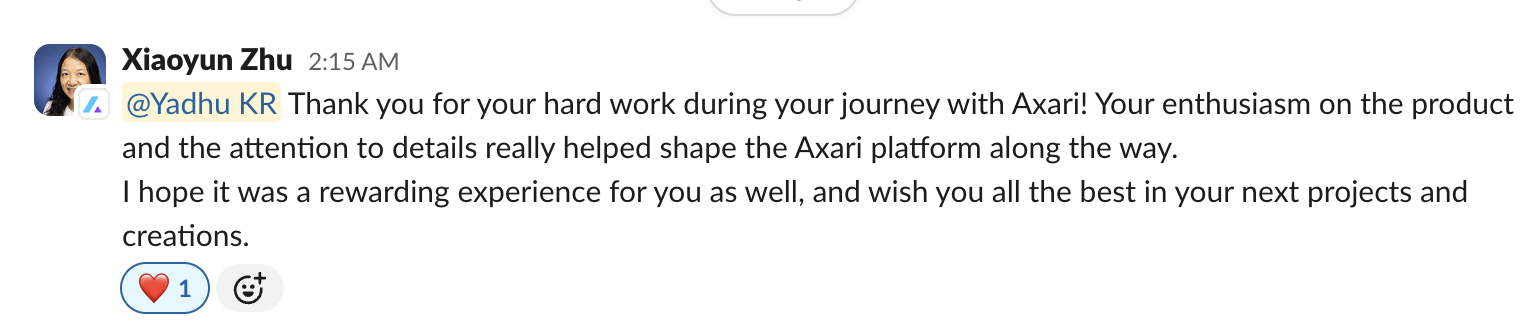
Xiaoyun Zhu · CTO
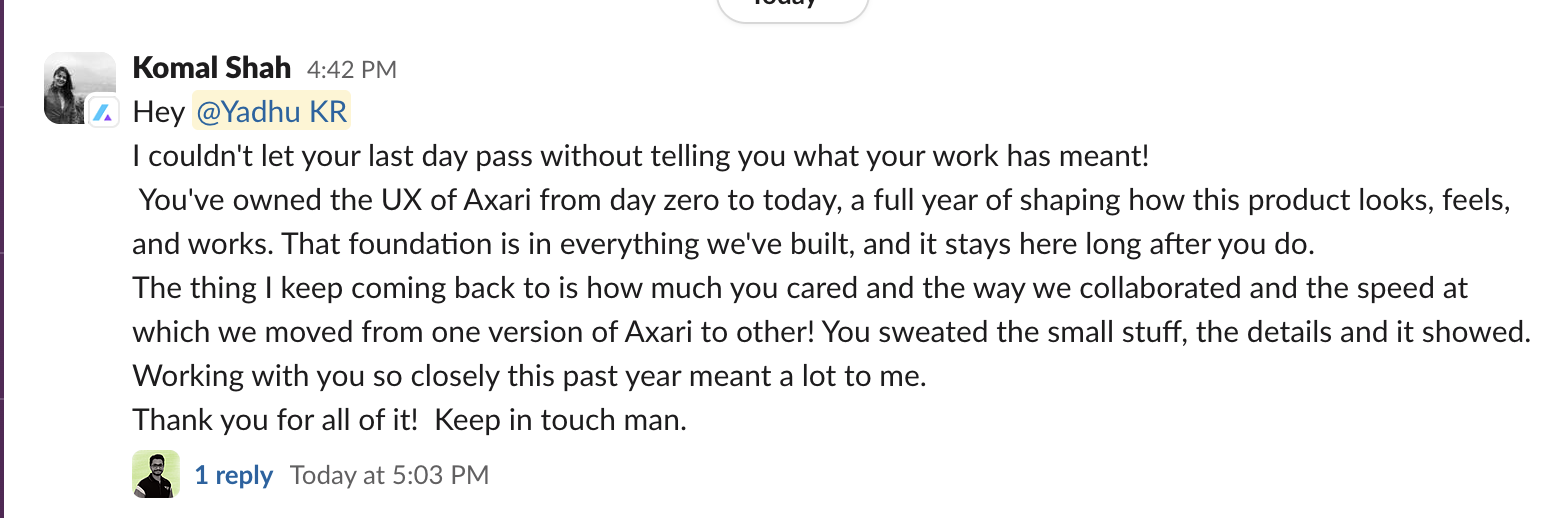
Komal Shah · Product Manager